
The transition from frame-based perception to event-driven intelligence, without replacing existing cameras.
No Rip-and-Replace
ERN-AI runs as a software layer on top of the digital CMOS hardware already deployed in factories, warehouses, and robotic platforms. No new sensors, no new silicon, no infrastructure migration.
Radically Lower Costs
By extracting and processing only meaningful events instead of every frame, ERN-AI drastically reduces bandwidth consumption, GPU inference cost, and storage volume across large camera fleets.
Built for Scale
The architecture is modular. AI-Lego-Blocks can be composed into arrays sized to the deployment, from a single 1×1 block to 10×10 configurations and beyond — the same software for one inspection station or ten thousand.
The Right Moment
As physical AI moves from research into industrial deployment, perception has become the bottleneck. NuMorph provides perception-response native AI at the point where the sensing happens.
Sensing data is broken — over 95% of it is redundant.
A camera running at 30 fps in a static warehouse aisle transmits thirty nearly identical images every second. The information content changes only when something moves — everything else is duplicated pixels consuming bandwidth, inference cycles, and disk.
ERN-AI is a perception-native compute layer that sits between the sensor and the AI stack, converting continuous frame data into sparse event representations before it ever reaches the network or the GPU. Redundancy is removed at the point of capture, where it originates.
AI-Lego-Block (ALB)
The atomic unit, a micro-scale neuromorphic element from honeybee neurology. ~1000× lower power, trained on local micro-data, executing device-natively.
NESA Arrays
The Neuromorphic Edge Sensing Array organizes ALBs into a layered structure — evolutionary and reconfigurable in real time as scene conditions change. Tested 1×1 to 10×10.
Patent Pending
ERN-AI is patent pending. Proof-of-concept demonstrations are complete and available for review under NDA — including ~500× compute reduction at 10×10.
Where ERN-AI delivers return fastest.
Factory Automation →
Thousands of cameras stream video that mostly shows a line running normally. ERN-AI processes feeds as event streams — a line to spec produces almost no events; a deviation produces events immediately, at the sensor.
Machine Inspection →
Defect detection no longer needs a GPU per frame. The ALB array operates on extracted events, so inference cost tracks meaningful change rather than frame rate — higher line speeds on the same hardware.
Warehouse Robotics →
Resolution, latency, and battery pull against each other in frame-based systems. Event-driven sensing decouples them: data volume scales with scene activity, not resolution — higher-res perception without the power penalty.
Smart Manufacturing →
Industry 4.0 stalls when legacy cameras aren't AI-ready. ERN-AI is a software retrofit that adds event-driven intelligence without full system replacement — an infrastructure project becomes a deployment.
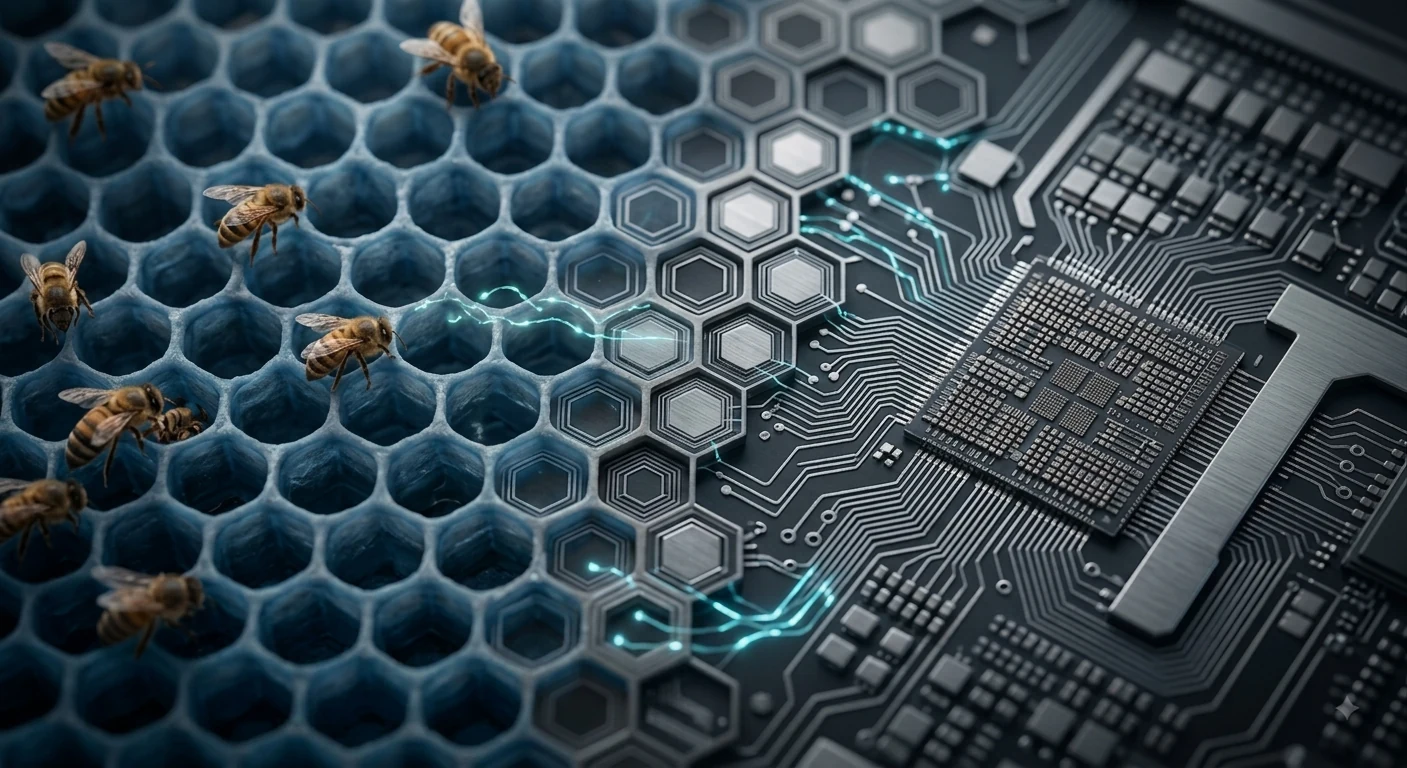
"Building Nature-Inspired Bio-morphic Intelligence for the Physical-AI World."
Video transcript
Welcome to NuMorph AI. Building bottom-up neuromorphic AI for vision sensing. Inspired by the vision and intelligence of honeybees for robots and drones at the edge. Low power analog AI modules for scalable ERN-AI. Evolutionary reconfigurable neuromorphic ERN-AI software. Neuromorphic vision for event-driven cameras for smart city safety cameras, aviation drones, medical vision systems, agriculture, industrial automation and in space. Honeybee-inspired AI vision systems. Modular ERN-AI neuromorphic edge sensing arrays module. NuMorph AI. Bee the Future. We are here.
Have questions? Read our FAQ.